reading-notes
JavaScript Object Basics
-
An object in JavaScript is like a container that can hold various pieces of information. Think of it as a virtual box where you can put things like names, ages, colors, and even special actions. These things inside the box are called properties, and each property has a name and a value.
-
Object literals are a simple way to group related data and functionality together.They are flexible and allow you to store a variety of data types, such as numbers, text, or even other objects. Objects provide an organized structure for your code, making it easier to work with complex data.
-
How do objects differ from arrays? Objects and arrays are both used to store data, but they have some key differences:
Objects use named properties to access their data, while arrays use numeric indexes. Objects are best for storing data with specific labels, making them suitable for representing things like people with names, ages, and addresses. Arrays are ideal for storing collections of similar data, such as a list of numbers or strings.
-
Give an example for when you would need to use bracket notation to access an object’s property instead of dot notation. Imagine you have an object representing a person’s contact information:
const person = {
  first name: 'John',
  last name: 'Amy',
};
// To access the ‘first name’ property using bracket notation:
const firstName = person[‘first name’];
// To access the ‘last name’ property using dot notation: const lastName = person.last name; // This would result in an error.
Bracket notation is necessary when the property name contains spaces or special characters.
-
Evaluate the code below. What does the term this refer to, and what is the advantage of using this?
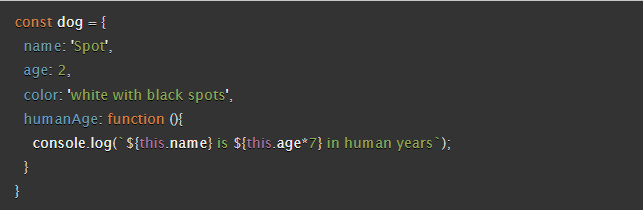 The code defines an object named dog with properties like name, age, color, and a method humanAge. In the context of this code, the term this refers to the current instance of the dog object. It is used to access the object’s own properties and methods. In the humanAge method, this.name and this.age refer to the specific name and age properties of the dog object.
The advantage of using this is that it allows the code to work with the specific instance of the object, making it reusable for different dogs. This way, you don’t have to rewrite the same code for each individual dog, and it can access and manipulate its own data.
Introduction To The DOM
-
What is the DOM?
The DOM is like a map of a web page that web browsers create. This map represents the page’s elements (like HTML tags), attributes, and text in a tree-like structure. JavaScript, a programming language, can use this map to change and work with the web page. So, JavaScript and the DOM are like partners: JavaScript uses the DOM to make web pages do things like update content, change how things look, and respond to what users do. This partnership between JavaScript and the DOM is what makes web pages interactive and able to respond to users.
Bookmark and Review:
Understanding the problem domain is the hardest part of programming. The problem domain in programming refers to understanding the problem you’re trying to solve and the requirements involved. It’s often the most challenging aspect of programming because it requires you to grasp the problem’s nuances, define clear objectives, and plan how to implement a solution effectively. Without a solid understanding of the problem domain, it’s difficult to write good code.
Things I want to know more about :
- Understand data structures and algorithms for more efficient coding.
- Explore best practices for code organization and design patterns.